
Modesto sits in the heart of Stanislaus County, surrounded by some of California's most productive agricultural land and drawing water from a combination of surface and groundwater sources. For residents here, a common question arises: does it matter whether your home uses city water or a private well? And how different are the filtration needs?
The short answer: they're different problems requiring different solutions. City water goes through regulated treatment before it reaches your tap. Well water arrives at your tap entirely unprocessed, with whatever the ground around you has contributed. Both can have serious water quality issues — but the risks, the testing approach, and the solutions differ in important ways.
This guide walks through both situations in depth for Modesto-area residents, including the neighborhoods and rural areas in Stanislaus County where private wells are common.
Modesto's Water Sources: A Quick Overview
Modesto Irrigation District (MID) and the City of Modesto Public Works Water Division supply municipal water to most of Modesto proper. The primary sources include Tuolumne River surface water (via the Modesto and Turlock Irrigation Districts' canal system) and Stanislaus County groundwater.
The blend used changes by season. During wetter months and higher river flows, Modesto draws more surface water. During drought conditions or summer peak demand, the groundwater contribution increases. This seasonal variability is important because surface water and groundwater have very different chemistry — surface water tends to have lower hardness and more organic content, while groundwater is typically harder and more minerally consistent.
Private wells in Stanislaus County are most common in:
- Rural areas around Riverbank, Oakdale, and Empire
- Unincorporated community pockets east of Highway 99
- Agricultural parcels that haven't connected to city service
- Some older properties within Modesto's historical rural fringe
If you're not certain whether your home uses city water or a private well, check your water bill. City customers receive bills from the City of Modesto or MID. If you don't have a water bill for your drinking water, you're almost certainly on a private well.
---
City Water in Modesto: What the Testing Shows
Modesto's municipal water suppliers are required to publish annual Consumer Confidence Reports (CCRs) — detailed analyses of what's in the water and whether it meets EPA standards. Here's what those reports and independent testing consistently show for Modesto city water:
Hardness: 8 to 18 gpg
Modesto's hardness varies significantly with the source blend. During high surface water periods (winter/spring), hardness can be relatively moderate at 8-12 gpg. During summer and drought-year groundwater-heavy periods, hardness climbs to 14-18 gpg. Both ranges qualify as "hard" to "very hard" — far above the soft water threshold of 3 gpg.
The practical effects of hard water in Modesto homes:
- Scale buildup inside water heaters, reducing efficiency by 12-24% annually
- White mineral deposits on faucets, showerheads, and glass surfaces
- Reduced soap lathering, meaning you use more detergent for the same result
- Shorter lifespan for dishwashers, washing machines, and ice makers
Chloramines
Like Fresno and most larger Central Valley municipal utilities, Modesto uses chloramines as a secondary disinfectant rather than free chlorine. Chloramines produce fewer regulated disinfection byproducts (trihalomethanes and haloacetic acids) and persist longer in the distribution system.
However, chloramines are more challenging to remove with standard carbon filtration. Catalytic carbon is needed for effective chloramine reduction — standard activated carbon filters have limited efficiency against the chloramine molecule.
Nitrates
Stanislaus County is one of the most intensively farmed counties in California, with dairy operations, tree nuts, stone fruits, row crops, and vineyards all contributing nitrogen compounds to the groundwater. Modesto's water utilities manage nitrate levels actively, but the pressure on groundwater is real. The EPA maximum contaminant level (MCL) for nitrates is 10 mg/L. Modesto city water typically stays below this, but seasonal spikes and specific groundwater source variability mean it's worth monitoring.
PFAS (Emerging Concern)
Per- and polyfluoroalkyl substances (PFAS) are a growing concern in Stanislaus County groundwater. The state of California has some of the most aggressive PFAS monitoring in the nation, and several Central Valley utilities have detected PFAS compounds above state notification levels. Modesto's water system is actively monitored. For residents who want maximum protection against PFAS, under-sink reverse osmosis is currently the most effective in-home treatment.
TDS: 100 to 300 mg/L
Total dissolved solids in Modesto city water vary with the source blend. At 100-300 mg/L, the range spans from moderately to noticeably mineral-heavy. You're more likely to notice this at the higher end of that range — water with flat taste, residue on dishes, and that Modesto-specific "water taste" that longtime residents know well.
---
Private Well Water in Stanislaus County: A Different Set of Problems
Private wells access groundwater directly — the same aquifer the agricultural fields and dairies above it drain into. Unlike city water, private well water:
- Is never treated before it reaches your tap
- Is tested only as often as you choose to test it
- Has no regulatory requirement for contaminant monitoring (for residential wells in California)
- Can change composition significantly after rain events, agricultural application seasons, or seismic activity
The well water problems specific to Stanislaus County and the Modesto area include:
Nitrates: The Primary Agricultural Contamination
This is the big one for Stanislaus County well users. The county has some of the highest documented nitrate contamination in California's agricultural groundwater, with many wells — particularly those in dairy-adjacent areas and intensive vegetable farming zones — testing above the EPA's 10 mg/L limit.
Nitrates above 10 mg/L are a serious health risk for:
- Infants under 6 months (causes "blue baby syndrome" — methemoglobinemia)
- Pregnant women
- People with certain blood disorders
Adults generally tolerate nitrates above the MCL without acute effects, but long-term exposure has been associated with increased cancer risk in epidemiological studies.
Standard whole house carbon filters do not remove nitrates. Neither do water softeners. The only in-home treatment technologies that effectively address nitrates are:
- Reverse osmosis (most common residential solution)
- Ion exchange anion resin systems (designed specifically for nitrates)
- Distillation
If you're on a well in Stanislaus County and haven't tested for nitrates recently, this is the most urgent reason to do so.
Coliform Bacteria and E. coli
Agricultural operations — particularly the large dairy operations east and south of Modesto — create significant pathogen pressure on shallow groundwater. Well depth matters: deeper wells (100+ feet) are more protected than shallow wells (under 50 feet), but no private well is entirely immune to bacterial contamination.
After heavy rain events, bacteria risk increases substantially as surface runoff carries pathogens toward well casings and into surrounding soil. Any well user in an agricultural area should test for coliform bacteria annually — and immediately after significant flooding.
Bacteria are not removed by carbon filtration, water softeners, or RO alone. UV purification is the standard residential solution for bacteria, providing effective kill rates against coliform, E. coli, Giardia, and Cryptosporidium without chemicals.
Iron and Manganese
Stanislaus County groundwater, particularly from deeper wells, often contains elevated iron and manganese. Iron above 0.3 mg/L causes rust-colored staining on fixtures, laundry, and dishes. Manganese above 0.05 mg/L produces blackish-brown staining. Both are aesthetic problems; manganese at higher levels has been associated with neurological concerns in long-term exposure research.
Iron and manganese require specialized treatment — either an oxidizing filter (greensand or Birm media), a chemical feed system, or an air injection system. Standard carbon filters and RO membranes are not optimized for high iron levels and can foul rapidly with excessive iron loading.
Arsenic
Naturally occurring arsenic in Stanislaus County groundwater is documented, particularly in areas with certain geological formations. California's maximum contaminant level for arsenic is 10 ppb (same as the federal standard), but health researchers increasingly suggest the safe level may be lower. Some private well tests in the county have returned levels of 15-30 ppb.
Arsenic is colorless, odorless, and tasteless — you can't detect it without testing. Long-term arsenic exposure is associated with bladder, lung, and skin cancers.
Arsenic removal requires specific media (such as activated alumina or ferric oxide) or reverse osmosis (RO reduces arsenic substantially, though point-of-use RO addresses drinking water only, not whole-house exposure).
Hardness: Often Higher Than City Water
Well water in Stanislaus County typically runs 15 to 30 gpg — on the harder end even compared to Modesto city water. Groundwater picks up calcium and magnesium as it percolates through limestone and mineral-bearing rock over decades. Without surface water dilution (which city water gets from Tuolumne River), well water hardness can be persistently extreme.
---
Head-to-Head: City vs. Well Filtration Needs in Modesto
Here's a direct comparison of the primary water quality concerns and what solutions address each:
| Issue | City Water (Modesto) | Well Water (Stanislaus County) | Treatment |
|---|---|---|---|
| Hardness | Moderate-high (8-18 gpg) | High-very high (15-30 gpg) | Water softener |
| Chloramines | Present | Not present | Catalytic carbon filter |
| Nitrates | Usually below MCL | Potentially above MCL | RO or anion exchange |
| Bacteria | Treated (but risk if pipes are old) | Untreated — real risk | UV purification |
| Arsenic | Very low | Possible — test required | Specific media or RO |
| Iron/Manganese | Usually low | Potentially elevated | Oxidizing filter |
| TDS | 100-300 mg/L | 150-400 mg/L | RO |
| PFAS | Monitored, possible low levels | Unknown without testing | RO |
Key takeaway: City water has a regulated baseline — it's treated and tested before delivery. Well water has no regulatory floor — the burden of testing and treatment falls entirely on the homeowner.
---
Recommended Filtration Systems for Modesto City Water Users
For a typical Modesto household on city water, the priority stack is:
Priority 1: Address hardness. A salt-based water softener is the highest-ROI single investment for most Modesto homeowners. At 8-18 gpg, you're clearly in the range where scale damage to appliances is occurring every day without treatment. A softener costs $800-$2,500 for the equipment plus installation.
Priority 2: Address chloramines and taste. A catalytic carbon whole house filter paired with the softener handles chloramines, chlorine, and taste/odor compounds. Budget $500-$1,200 for this stage.
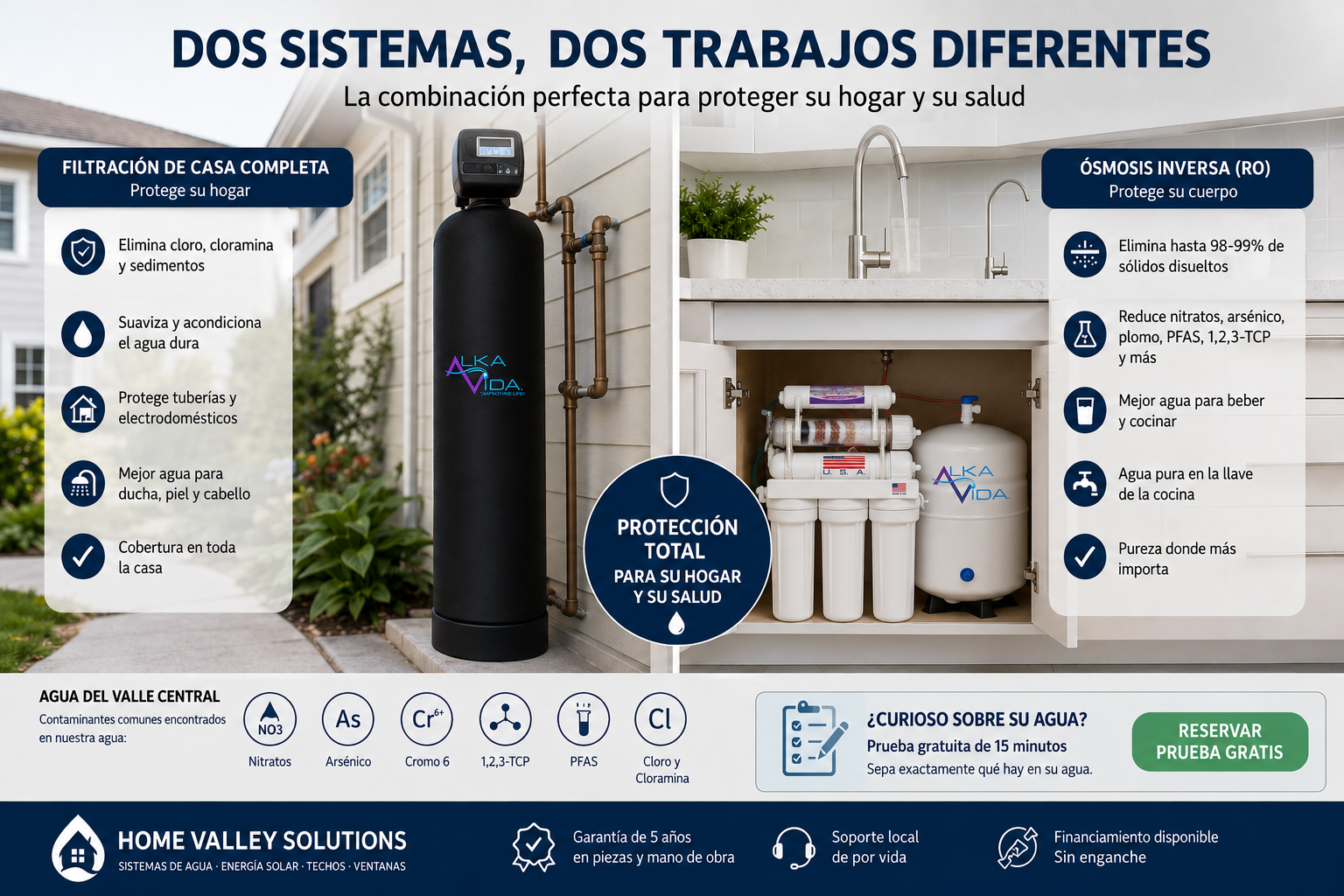
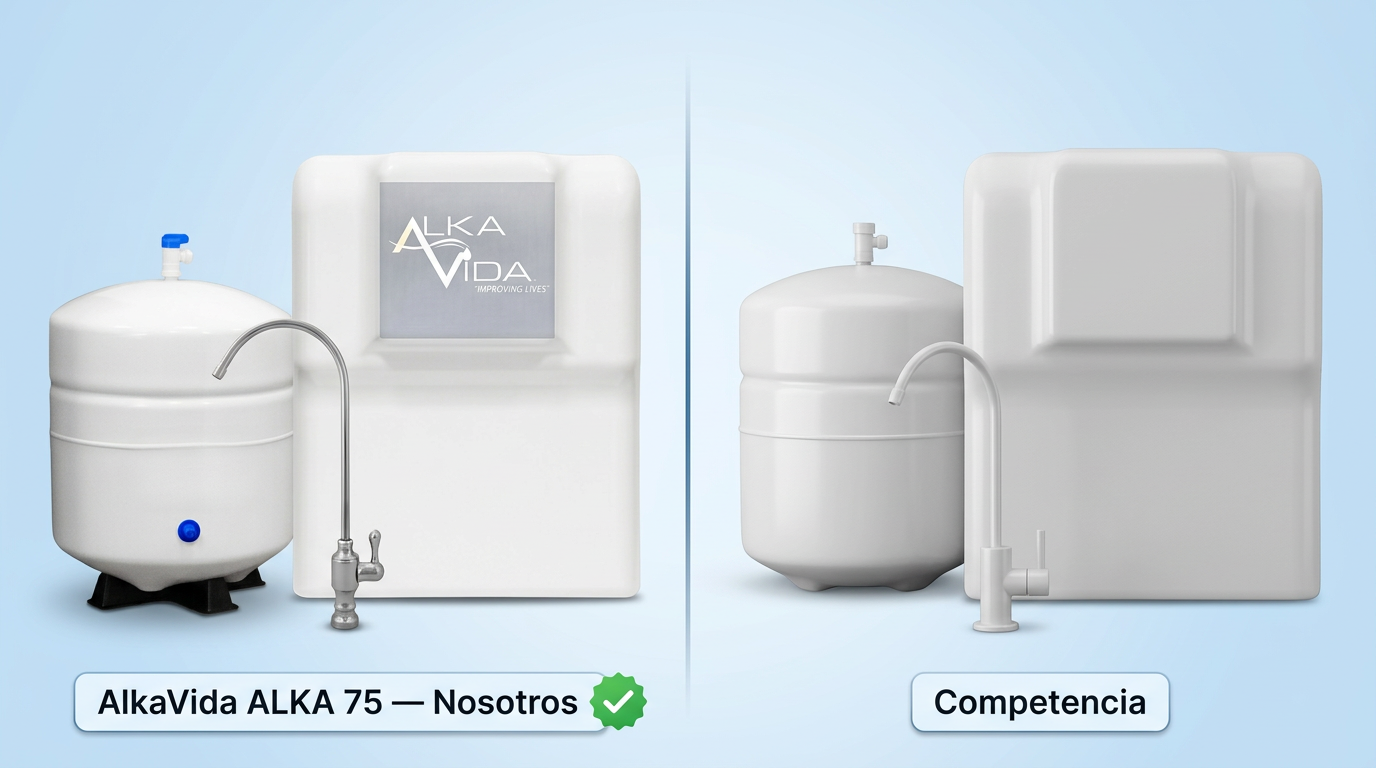
Priority 3: Drinking water quality. Pair the whole house system with an under-sink reverse osmosis system at the kitchen sink. RO brings TDS down dramatically, addresses any trace nitrates, PFAS, and disinfection byproducts in your drinking water. Options include standard APEC/SpringWell units ($200-$500 for the equipment) or Home Valley Solutions' AlkaVida alkaline RO system, which adds remineralization and alkaline pH (8.5-9.5) after the RO stage.
Total for a complete city-water system: $2,000-$4,500 installed
[Explore whole house water filtration options](https://www.homevalleysolutions.com/services/water-filtration?utm_source=blog&utm_medium=seo&utm_campaign=comparison_blogs&utm_content=well-water-vs-city-water-modesto-filtration-needs)
[Learn about reverse osmosis systems](https://www.homevalleysolutions.com/services/reverse-osmosis?utm_source=blog&utm_medium=seo&utm_campaign=comparison_blogs&utm_content=well-water-vs-city-water-modesto-filtration-needs)
---
Recommended Filtration Systems for Stanislaus County Well Water Users
For well water users, the approach must be test-first, treat-second. There's no responsible way to recommend a system without knowing what's in your water. That said, a comprehensive well water treatment system in Stanislaus County typically includes:
Essential stages:
1. Sediment pre-filter (5-10 micron): Catches particulate matter to protect downstream components.
2. Iron/manganese filter (if elevated): Required before the softener — high iron fouls softener resin.
3. Water softener: Addresses hardness (typically 15-30 gpg for well water). Size appropriately for your flow rate and daily demand.
4. UV purification: Non-negotiable for well water in agricultural areas. Addresses bacteria, viruses, Giardia, Cryptosporidium.
5. Under-sink RO for drinking water: Addresses nitrates, arsenic (substantially), PFAS, and remaining dissolved contaminants. This is the critical layer for food-preparation and drinking water given Stanislaus County nitrate pressures.
Optional/conditional stages:
- Arsenic-specific media if testing shows elevated arsenic
- Air injection oxidation for high iron before the iron filter
- Activated alumina stage for confirmed arsenic above 10 ppb
Total for a comprehensive well treatment system: $3,500-$7,000 installed
The higher cost reflects the additional stages required and, often, the greater complexity of installation at rural well-served properties.
---
How to Get Your Well Tested: Practical Steps for Modesto-Area Residents
Testing a private well in Stanislaus County:
Option 1: Start with a free in-home test. Home Valley Solutions conducts in-home water tests that cover hardness, TDS, pH, and chlorine/chloramine levels at no charge. For well water, this gives you baseline numbers quickly.
[Schedule your free water test](https://www.homevalleysolutions.com/free-water-test?utm_source=blog&utm_medium=seo&utm_campaign=comparison_blogs&utm_content=well-water-vs-city-water-modesto-filtration-needs)
Option 2: Certified lab testing for a full panel. For well water, we recommend a certified lab panel that includes:
- Bacteria (total coliform and E. coli)
- Nitrates
- Arsenic
- Iron and manganese
- pH, TDS, hardness
- Optionally: PFAS, VOCs, and pesticides if you're near agricultural operations
The Stanislaus County Environmental Resources Division can refer you to certified labs. Prices for comprehensive panels run $150-$400. This cost is entirely worth it before investing $3,000-$7,000 in a treatment system.
Option 3: Stanislaus County Environmental Resources. The county has programs to assist well owners in contaminated areas, including some subsidized testing for low-income households. Check with them if cost is a barrier.
---
The Comparison Companies and What They Offer for Well vs. City Water
Culligan: Works with both city and well water customers. Their in-home rental approach means a service technician regularly maintains the system — appealing for well water customers who may not want to manage iron filter backwash cycles and UV lamp replacement schedules themselves. The $40-$60/month rental cost doesn't reflect the complexity difference between a city water softener setup and a comprehensive well treatment system, so confirm what's actually included.
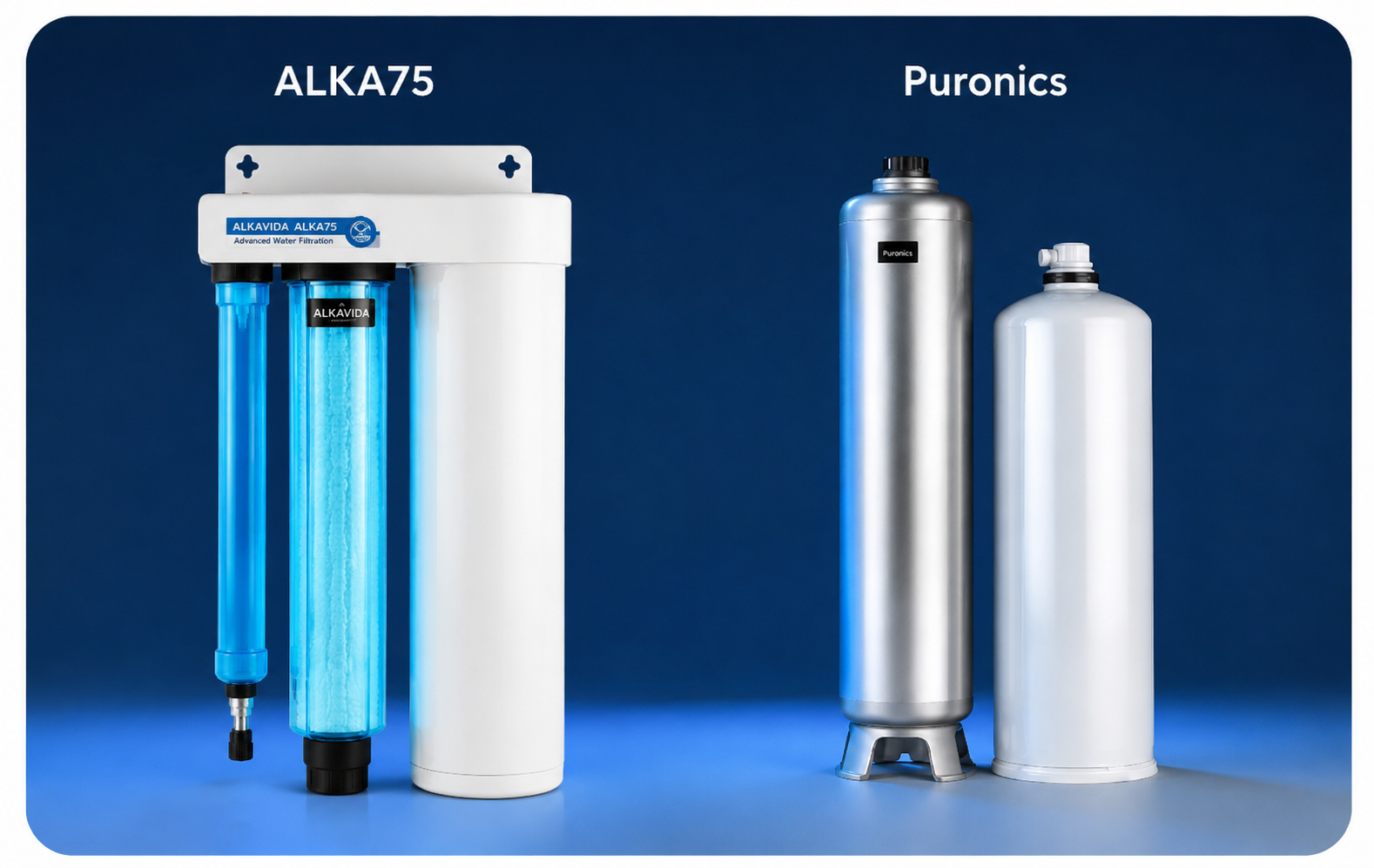
RainSoft and Puronics: Both focus primarily on softening and whole house filtration. Their systems at $4,000-$8,000 (RainSoft) and $3,000-$6,000 (Puronics) are marketed more toward city water customers in the suburban/residential installation context. For complex well water treatment with iron filters, UV, and RO, these companies can do it, but make sure the system they're proposing addresses your specific well test results.
Kinetico: Their twin-tank non-electric softeners work well for both city and well water applications. For high-iron well water, confirm the iron filter stage is part of the proposal — iron fouls softener resin and must be addressed upstream.
EcoWater: Similar to Kinetico in terms of applicability. Their systems work for both contexts. The Wi-Fi monitoring feature is particularly useful for well water customers who benefit from knowing when salt is getting low or when usage patterns change unexpectedly.
LifeSource: Salt-free conditioning is primarily a city water solution. For well water with hardness at 20-30 gpg, traditional salt-based softening typically outperforms salt-free conditioning significantly.
APEC, SpringWell, Aquasana: Online direct brands are a viable option for city water customers with DIY ability. For complex well water treatment, the multi-stage design requires expertise to size and sequence properly — the savings from DIY installation can be offset by an improperly designed system.
Home Valley Solutions: Serves both city water and well water customers throughout Stanislaus County. For well water customers specifically, HVS conducts the initial free test, recommends certified lab testing when needed, and designs the treatment system based on your specific test results rather than a standard package. [Book an appointment](https://www.homevalleysolutions.com/appointment?utm_source=blog&utm_medium=seo&utm_campaign=comparison_blogs&utm_content=well-water-vs-city-water-modesto-filtration-needs).
---
Long-Term Cost Comparison: City Water vs. Well Water Treatment
City water treatment (softener + whole house filter + under-sink RO):
- Installation: $2,000-$4,500
- Annual ongoing: $150-$400 (salt, filters, RO membrane every 2-3 years)
- 10-year total cost of ownership: $3,500-$8,500
- 10-year cost without treatment (appliance damage, bottled water, scaled plumbing): Estimated $3,000-$8,000 in early appliance replacement, reduced efficiency, and bottled water spending
Well water treatment (full system):
- Installation: $3,500-$7,000
- Annual ongoing: $300-$700 (salt, filters, UV lamp replacement every 1-2 years, RO membranes)
- 10-year total cost of ownership: $6,500-$14,000
- 10-year cost without treatment (health risk, appliance damage): Incalculable if water is contaminated with nitrates, arsenic, or bacteria
The well water calculation is starkly different because untreated well water isn't primarily a convenience or appliance-protection issue — it's potentially a health issue. The cost of not treating contaminated well water can be severe.
---
Signs Your Water Needs Attention — Whether City or Well
You don't necessarily need to wait for a water test to know something's off. Watch for:
Signs specific to hard water (both city and well):
- White chalky deposits on faucets, showerheads, tile grout
- Soap that doesn't lather well, feeling like you can't get fully rinsed
- Dishes and glassware with filmy spots after the dishwasher
- Reduced water pressure as scale narrows pipes over time
Signs specific to well water problems:
- Rust staining on sinks, toilets, or laundry (iron)
- Rotten egg smell (hydrogen sulfide — a sulfur compound common in some groundwater)
- Metallic taste
- Cloudy water that clears when left to sit (dissolved gas or sediment)
- Seasonal taste changes after rain events
Signs that affect both but suggest chemical contamination:
- Water that tastes noticeably different from bottled water
- Repeated stomach issues that don't have another obvious cause (seek medical attention if severe)
- Old plumbing + high TDS = elevated lead risk (test specifically for lead if your pipes are pre-1986)
---
The Free First Step: Know Your Water
Whether you're on city water in central Modesto or a private well in rural Stanislaus County, the starting point is the same: actual data about your specific water.
Home Valley Solutions provides free in-home water testing for Modesto-area residents. The test covers hardness, TDS, pH, and chlorine levels. For well water customers, we'll also discuss what additional certified lab testing makes sense for your location and usage situation.
There's no sales pressure. You'll leave the appointment with real information about your water, and if treatment makes sense, you'll get an honest recommendation and competitive pricing.
[Schedule your free water test in Modesto](https://www.homevalleysolutions.com/free-water-test?utm_source=blog&utm_medium=seo&utm_campaign=comparison_blogs&utm_content=well-water-vs-city-water-modesto-filtration-needs)
Call (559) 507-6838 to reach us directly.
[View our full service menu](https://www.homevalleysolutions.com/services/water-filtration?utm_source=blog&utm_medium=seo&utm_campaign=comparison_blogs&utm_content=well-water-vs-city-water-modesto-filtration-needs)
[Learn about AlkaVida alkaline systems](https://www.homevalleysolutions.com/services/alkaline-water?utm_source=blog&utm_medium=seo&utm_campaign=comparison_blogs&utm_content=well-water-vs-city-water-modesto-filtration-needs)
---
Summary: The Key Differences Between City and Well Water Treatment in Modesto
City water advantages: Treated, tested, regulated. Known contaminants are managed to EPA standards. The primary issues — hardness and chloramines — are significant but addressable with a straightforward softener + catalytic carbon filter combination.
Well water realities: No treatment before your tap. No regulatory testing requirement. High risk of nitrate contamination in Stanislaus County's agricultural setting. Potential arsenic, bacteria, and iron issues. Test before you treat — and treat comprehensively if contamination is found.
Cost difference: City water treatment: $2,000-$4,500 installed for a comprehensive system. Well water treatment: $3,500-$7,000 installed for a complete multi-stage system. The higher well water cost reflects additional necessary stages, not inflated pricing.
Bottom line: Both city and well water in the Modesto area benefit from treatment. The stakes and the solution complexity are higher for well water users. Either way, start with a water test.
---
Home Valley Solutions is a local, family-owned water filtration company serving Modesto, Stanislaus County, and the entire Central Valley. Free water testing with no obligation, bilingual service, and honest recommendations for city and well water customers. Call (559) 507-6838.
Ready to Improve Your Water Quality?
Get a free water test and discover how we can help you.