
Table of Contents
1. [What Is TDS and Why Does It Matter?](#what-is-tds) 2. [Atwater's Water Quality Problem: The Numbers](#atwater-water-quality) 3. [Why Atwater Water Tastes the Way It Does](#why-water-tastes-bad) 4. [Health Implications of High TDS Water](#health-implications) 5. [Agricultural Runoff and Nitrate Concerns in Merced County](#ag-runoff-nitrates) 6. [Well Water in Atwater: A Separate Problem Entirely](#well-water-atwater) 7. [How to Test Your TDS Right Now](#how-to-test) 8. [Water Treatment Solutions Compared](#solutions-compared) 9. [Company-by-Company Breakdown: What You'll Actually Pay](#company-breakdown) 10. [Why Atwater Families Choose Home Valley Solutions](#why-hvs) 11. [Frequently Asked Questions](#faq) 12. [Take Action: Get Your Free Water Test](#cta)
---
What Is TDS and Why Does It Matter? {#what-is-tds}
TDS stands for Total Dissolved Solids — a measurement of everything dissolved in your water that isn't H2O itself. That includes minerals like calcium, magnesium, potassium, and sodium, but also less welcome guests: nitrates, chlorides, sulfates, heavy metals, and agricultural chemicals.
TDS is measured in parts per million (ppm) or milligrams per liter (mg/L) — the two are essentially the same number. A reading of 1 ppm means 1 milligram of dissolved material for every liter of water.
Here's the general scale water quality professionals use:
| TDS Range | Water Classification |
|---|---|
| 0–50 ppm | Excellent (reverse osmosis or distilled) |
| 50–150 ppm | Good (typical spring water) |
| 150–250 ppm | Fair (some mineral taste begins) |
| 250–500 ppm | Poor (noticeable taste, scaling) |
| 500–1,000 ppm | Very Poor (EPA secondary standard exceeded) |
| 1,000+ ppm | Unacceptable for drinking |
The EPA's secondary standard for TDS in drinking water is 500 ppm. Secondary standards are not enforceable — they're aesthetic guidelines. What that means in practice: your water utility can legally deliver water above 500 ppm to your tap without violating a single law. The primary standard (enforceable) doesn't cover TDS at all.
That gap between "legal" and "good" is exactly where a lot of Atwater households live every day.
TDS matters for several interconnected reasons. It affects how your water tastes and smells. It determines how aggressively your water scales pipes, appliances, and fixtures. It provides a signal that specific contaminants — some of them health-relevant — may be present. And it affects how well your water works for everyday purposes like cooking, brewing coffee, and washing clothes.
A high TDS reading is not a diagnosis — it's a red flag that says "get a real test." But for most Atwater residents, the red flag has been flying for years. The mineral-heavy taste, the white residue on faucets, the spotted dishes, the constantly failing water heater elements — these are not coincidences. They are the predictable outputs of water with 200–500+ ppm of dissolved solids passing through your home every day.
Understanding the problem is the first step to solving it. This guide walks through the science, the local data, the health context, and the practical options — so you can make an informed choice about how to fix your water rather than just accepting it.
---
Atwater's Water Quality Problem: The Numbers {#atwater-water-quality}
Atwater sits in the heart of the San Joaquin Valley, one of the most productive agricultural regions on Earth and also one of the most water-stressed. That combination creates a predictable water quality challenge: high mineral content from the underlying geology, compounded by decades of intense agriculture that has left its mark on the groundwater.
Typical TDS readings in Atwater range from 200 ppm on the low end to well over 500 ppm in areas with heavier agricultural influence or older infrastructure. Homes on private wells — common throughout the unincorporated fringes of Atwater and throughout Merced County — frequently see TDS readings pushing 600–900 ppm.
Hardness is the other headline number. Atwater water runs 12 to 25 grains per gallon (gpg) of hardness, which translates to roughly 205–428 mg/L. Water hardness above 7 gpg is generally classified as "hard." Atwater isn't just hard — it's very hard to extremely hard depending on the season and your location within the city.
This hardness is primarily calcium carbonate — the white chalky mineral that leaves rings inside your toilet bowl, stiff residue on your shower tiles, and cloudy spots on every glass you own. But hardness is part of the broader TDS picture. Every grain of hardness you have contributes to your total dissolved solids count.
Key water quality markers in Atwater (based on publicly available utility data and local testing averages):
- TDS: 200–500+ ppm (well water often 500–900 ppm)
- Hardness: 12–25 gpg (very hard to extremely hard)
- Chlorine/Chloramine: Present as municipal disinfectant
- Nitrates: Elevated in agricultural proximity zones
- Silica: Moderate to elevated, common in Central Valley groundwater
- Sodium: Elevated in areas with softener discharge and agricultural irrigation return flows
- Turbidity: Generally within range but varies by season and source
The geographic reality of Atwater compounds these challenges. The city draws primarily from groundwater wells that tap the same aquifer system influenced by decades of intensive farming. Unlike surface water systems that can blend from multiple sources, groundwater systems reflect the specific chemistry of the formations they draw from. In Merced County, those formations have been shaped by agriculture, by the natural mineral content of the Sierra Nevada drainage, and by the slow geological processes that deposited calcium-bearing rock across the valley floor.
None of this is the city's fault — it's geology and land-use history working together. But it is the water that comes out of your tap, and understanding where it comes from helps explain why it behaves the way it does.
---
Why Atwater Water Tastes the Way It Does {#why-water-tastes-bad}
If you've ever handed a glass of Atwater tap water to someone visiting from another city and watched their face, you already know the answer. But the chemistry behind the taste is worth understanding, because it tells you exactly what you're dealing with.
The mineral-heavy, chalky taste is your first clue. Calcium and magnesium — the minerals responsible for water hardness — leave a distinctly mineral, sometimes slightly bitter aftertaste. At 12–25 gpg, Atwater water has enough mineral content that most people can taste it clearly, especially when drinking a cold glass straight from the tap. This isn't a flaw in your perception. Studies on sensory thresholds confirm that humans can reliably detect hardness above 7–10 gpg in taste tests. You're tasting what's actually there.
The "pool water" or bleach note comes from chlorine or chloramine, which municipal systems use to disinfect water during treatment and distribution. This is a necessary part of delivering safe water, but the disinfectants don't simply disappear — they arrive at your tap. Chloramine (a chlorine-ammonia compound increasingly used by water utilities) is particularly persistent, persisting longer in the distribution system and being harder to remove with standard carbon filters. It produces a distinct chemical odor and taste.
The flat, heavy mouthfeel is a high-TDS signature. Water above 300–400 ppm starts to feel "thick" or heavy in your mouth compared to low-TDS water. This is especially noticeable when drinking a cold glass of water — there's a sense of weight to it that persists after swallowing. The World Health Organization has noted that waters above 600 ppm are generally described as "objectionable" by taste panels.
The impact on beverages and cooking:
Coffee is the most common complaint. High-TDS water over-extracts certain compounds from coffee grounds and under-extracts others, producing a bitter, harsh, or flat cup depending on the specific mineral profile. The Specialty Coffee Association recommends brewing water in the 75–250 ppm range. Atwater tap water is often 2–5 times that level.
Tea has the same problem — tannins and delicate flavor compounds are altered by high-mineral water, and the result is a murkier, more astringent cup than the same tea brewed with lower-TDS water.
Rice and pasta absorb the cooking water, which means they absorb its mineral content. Atwater families who switch to RO or filtered water for cooking consistently report that pasta tastes cleaner and that rice cooks more uniformly.
Ice cubes made from high-TDS tap water are cloudy (dissolved gases and minerals precipitate as the water freezes) and carry a noticeable mineral taste into drinks. This is why restaurant-quality ice machines use filtered water — and why your refrigerator ice tastes different from ice at a good restaurant.
The effect on soap and skin:
Calcium and magnesium ions react with soap molecules, forming a curd-like compound instead of lather. This is why Atwater residents use more soap, shampoo, and laundry detergent than people in low-mineral-content water areas. The soap is being "used up" fighting the minerals before it can do its cleaning work.
The same mineral film that interferes with soap also deposits on skin and hair. Atwater residents frequently report that their skin feels dry and tight after showering, and that their hair is harder to rinse clean and more prone to dullness. These are not imagined problems — they are the physical result of calcium and magnesium film depositing on hair and skin.
---
Health Implications of High TDS Water {#health-implications}
This is the section where we need to be careful and honest. High TDS water is not necessarily dangerous water — a lot depends on what exactly is contributing to the TDS number.
Calcium and magnesium are minerals your body needs. Drinking water that contains them is not harmful and may actually provide a small portion of your daily mineral intake. The WHO and most public health bodies acknowledge that moderate mineral content in drinking water is not a health concern and may even be marginally beneficial for cardiovascular health.
The concern with high-TDS water comes when the dissolved solids include contaminants with established health effects:
Sodium: In areas where water softeners are heavily used (common in hard water regions like Atwater), sodium is added to the water during the ion exchange softening process. People on sodium-restricted diets for heart disease, hypertension, or kidney conditions need to know how much sodium is in their softened water. A water softener serving Atwater water can add 100–300+ mg/L of sodium to already mineral-rich water. This is a meaningful dietary sodium contribution for someone consuming two liters of water per day.
Nitrates: The EPA maximum contaminant level (MCL) for nitrates is 10 mg/L (10 ppm). Merced County has documented elevated nitrate levels in groundwater in multiple locations, with some private well zones exceeding the MCL. Nitrates are particularly dangerous for infants under 6 months — they can cause methemoglobinemia, commonly called "blue baby syndrome," a condition where the blood's ability to carry oxygen is reduced. Infants cannot metabolize nitrates the way adults can, and water above the MCL must not be used to prepare formula or given directly to infants. Private well owners in Atwater and surrounding areas have found nitrate readings above the MCL on testing.
Heavy metals: Lead, arsenic, and chromium-6 can contribute to TDS and carry real health risks. Lead is particularly concerning in older homes where lead solder was used in plumbing connections — the water dissolves trace amounts of lead as it sits in the pipes. California has documented chromium-6 contamination in some Central Valley water systems. Arsenic occurs naturally in some Central Valley aquifers. None of these metals are detectable by taste or appearance.
Disinfection byproducts (DBPs): When chlorine reacts with naturally occurring organic matter in water, it forms trihalomethanes (THMs) and haloacetic acids (HAAs). These compounds have been associated with increased cancer risk and adverse reproductive outcomes at chronic high exposure. The EPA sets MCLs for both THMs and HAAs. California's standards are more stringent. Chloramine, the disinfectant more commonly used in Atwater's water system, forms different byproducts (including NDMA, a probable carcinogen) that carbon filtration must be specifically designed to address.
Fluoride: Added to municipal water at controlled levels for dental health, but at higher natural concentrations (which occur in some Central Valley wells), fluoride can cause dental and skeletal fluorosis. Municipal water is regulated to the optimal range; well water is not tested or adjusted.
The honest takeaway: a TDS reading tells you that something is in your water. A comprehensive water quality test tells you what. For Atwater households — especially those on private wells, those with infants, and those with health conditions that make specific contaminants a concern — testing is not optional. It is the baseline responsible act.
[Get a free professional water test from Home Valley Solutions — no commitment, no pressure, just accurate local data.](/free-water-test?utm_source=blog&utm_medium=seo&utm_campaign=comparison_blogs&utm_content=tds-levels-atwater-why-water-tastes-bad-how-to-fix)
---
Agricultural Runoff and Nitrate Concerns in Merced County {#ag-runoff-nitrates}
Merced County is surrounded by and interwoven with some of the most intensively farmed land in the world. Almonds, walnuts, tomatoes, dairy operations, row crops — the sheer volume of fertilizer, pesticides, and animal waste that enters the ground every year in this region is staggering.
Nitrogen-based fertilizers are the primary driver of nitrate contamination in Central Valley groundwater. When it rains, or when fields are over-irrigated (which happens routinely in high-production agriculture), nitrogen leaches through the soil into the aquifer below. That aquifer is the same one that feeds private wells throughout Merced County and contributes to the groundwater that Atwater's municipal wells draw from.
A landmark study from UC Davis found that 96% of nitrate contamination in the Tulare Lake Basin and Salinas Valley came from agricultural fertilizer applications. Merced County's water quality situation mirrors that pattern. The Central Valley Regional Water Quality Control Board has identified nitrate as one of the primary groundwater management concerns for the region, and the State Water Board's Nitrate Control Program specifically targets areas where fertilizer application has elevated groundwater nitrate.
For municipal water customers in Atwater, the city treats and blends water to keep nitrates within the legal limit. But "within the legal limit" is not the same as "below the level where health effects begin to appear in research." And for the thousands of Atwater-area residents on private wells, there is no treatment — you get what comes out of the ground.
The Merced County Environmental Health Department recommends testing well water for nitrates at least once a year, more frequently if you have infants, pregnant women, elderly individuals, or immunocompromised people in the household. This is not a formality — it is a genuine public health recommendation based on documented contamination in the region.
Additional agricultural chemicals of concern in the Merced County area include:
DBCP (Dibromochloropropane): A soil fumigant and nematocide that was banned in California in 1977 but persists in Central Valley groundwater because of its chemical stability. Some older wells in Merced County have tested positive. DBCP is a probable human carcinogen.
1,2,3-TCP (Trichloropropane): A byproduct of pesticide production that contaminated fumigant products used extensively in California agriculture before its detection as a groundwater pollutant. California set an MCL of 5 parts per trillion in 2017 — one of the most stringent standards in the country. Some Central Valley water systems have required treatment to meet this standard.
EDB (Ethylene Dibromide): Another legacy pesticide fumigant with documented groundwater persistence in parts of the Central Valley.
Glyphosate and other modern herbicides: Ongoing monitoring is required as usage levels remain high throughout the region. Research into groundwater persistence and health effects for newer agricultural chemicals continues to evolve.
Dairy and livestock waste: Merced County is one of the leading dairy regions in the country. Animal waste lagoons and land application of manure can contribute to both nitrate loading and pathogen contamination of groundwater in proximity to operations.
If your home is on a private well near agricultural land — or even if you're on municipal water and want to understand the full picture of what your water contains — testing is the only responsible path forward. Not a TDS meter. A real laboratory analysis.
---
Well Water in Atwater: A Separate Problem Entirely {#well-water-atwater}
A significant portion of homes in and around Atwater are not connected to the city's municipal water system. They rely on private domestic wells, and those wells exist entirely outside the regulatory framework that governs public water utilities.
No one tests your well water unless you arrange it yourself. No one monitors it. No one treats it. No government agency is responsible for its safety. You are the water utility.
This creates a very different risk profile than municipal water, and it means that well water households in the Atwater area need to approach water quality with particular seriousness. Here's what well water in this region commonly presents:
Higher TDS baseline. Municipal water is blended from multiple sources and treated, which averages out extreme readings. Well water reflects whatever the aquifer immediately below your property contains at the depth of your well. In agricultural zones around Atwater, that can mean TDS readings of 500–900 ppm or higher, with corresponding hardness levels that will aggressively attack appliances and make daily bathing noticeably unpleasant.
Sediment and turbidity. Well water may carry fine sand, clay particles, and iron oxide that city water treatment removes. These contribute to TDS but also to taste, color, and appliance wear. Sediment is particularly rough on tankless water heaters and RO membranes — which is why pre-filtration is essential in a well water system design.
Iron and manganese. Both are common in Central Valley well water. Iron above 0.3 mg/L stains laundry orange and rust-colored, turns toilet bowls red-brown, and gives water a distinctly metallic, blood-like taste. Manganese above 0.05 mg/L creates black or dark gray staining and has been associated in recent research with neurological effects in children at chronic exposure. Neither is visible at low concentrations — testing is required.
pH variation. Well water in the Central Valley can be either acidic (which causes copper leaching from plumbing) or highly alkaline (which contributes to scale and taste problems). Municipal water is buffered to a controlled pH range. Well water is whatever the geology produces.
Hardness extremes. Well water hardness in Merced County can exceed 30 gpg in some locations — significantly above the already-hard municipal water supply. At this level, water heater elements calcify within 2–3 years, dishwashers require regular acid descaling to function, and showerheads need replacement every 12–18 months.
Bacteria and biological contamination. Coliform bacteria, E. coli, and other biological contaminants can enter a well through casing cracks, poorly sealed well caps, surface water intrusion during flooding or heavy rain, or nearby septic system failures. Unlike municipal water, there is no continuous disinfection in a private well system. Annual bacteriological testing is essential.
No backup and no accountability. If your well pump fails, your water quality changes suddenly, or you discover contamination, you are the person responsible for diagnosing and solving the problem. There is no utility emergency line, no regulatory agency that will respond to fix your specific issue, and no fallback supply.
The water treatment approach for a well water home in Atwater must be designed around the specific results from a full well water analysis — not around a generic system designed for municipal water. The presence of iron, the hardness level, the sediment load, the nitrate concentration, and the bacteriological status all affect which treatment technologies are appropriate and how they should be sized and sequenced.
[Schedule a free home water test — we test well water and city water throughout the Atwater area.](/free-water-test?utm_source=blog&utm_medium=seo&utm_campaign=comparison_blogs&utm_content=tds-levels-atwater-why-water-tastes-bad-how-to-fix)
---
How to Test Your TDS Right Now {#how-to-test}
Before you spend a dollar on water treatment, you need to know what you're dealing with. Here are your testing options, from the simplest to the most comprehensive.
Option 1: TDS Meter (Immediate, Approximate)
A handheld TDS meter costs $10–25 on Amazon. You fill a small cup with water, dip the meter in, and get a reading in seconds. This tells you your total dissolved solids number — nothing more. You won't know what's in the water, which specific minerals or contaminants are contributing, or whether any health-relevant compounds are present.
Use a TDS meter as a starting point and a way to verify before-and-after performance of any treatment system you install. Don't make major purchase decisions based on a TDS meter reading alone.
To get an accurate TDS reading: run your tap for 30 seconds before testing (to flush stagnant pipe water), test at the kitchen sink (your primary drinking source), take three readings and average them, and note the temperature (TDS readings vary slightly with temperature, and most meters have a temperature compensation mode — make sure it's enabled).
Option 2: Mail-in Laboratory Test
Services like National Testing Laboratories (NTL), Tap Score, and SimpleLab offer mail-in panels that test for dozens of specific contaminants. A comprehensive residential panel runs $100–200 and returns results within 1–2 weeks. You collect the sample according to provided instructions and mail it to the lab.
This is a legitimate approach that provides a real breakdown of what's in your water. The limitation is that results take time, and without local expertise, interpreting the results and translating them into a treatment recommendation requires additional research.
For well water, a mail-in lab test should cover: TDS, hardness, pH, iron, manganese, nitrates, arsenic, lead, coliform bacteria, E. coli, and any locally relevant contaminants (DBCP, TCP, chromium-6 for Central Valley wells).
Option 3: Free Professional Test from Home Valley Solutions (Recommended for Atwater)
We offer free on-site water testing throughout the Atwater area with no obligation to purchase anything. Our water testing process includes:
- TDS measurement (with calibrated instrument, not a $15 meter)
- Total hardness (gpg and mg/L)
- pH
- Free chlorine and total chlorine/chloramine
- Iron (colorimetric test)
- Nitrate screening
- Additional parameters relevant to your specific situation (well vs. municipal, specific neighborhood, etc.)
We bring results to you immediately, explain every number in plain language (English or Spanish), and give you honest recommendations. If your water doesn't show a problem that treatment would solve, we tell you that. If it does, we explain the options without pressure.
A professional on-site test takes about 20 minutes and gives you far more actionable information than any mail-order kit — because the person reading your results knows Atwater's water specifically, can ask about your home's plumbing age, and can factor in local knowledge about your specific neighborhood's water quality patterns.
---
Water Treatment Solutions Compared {#solutions-compared}
Once you have your water test results, the next question is which technology addresses your specific problem. This matters more than most people realize — the wrong technology does nothing for your actual water issues while costing real money.
Reverse Osmosis (RO) — The Gold Standard for TDS Reduction
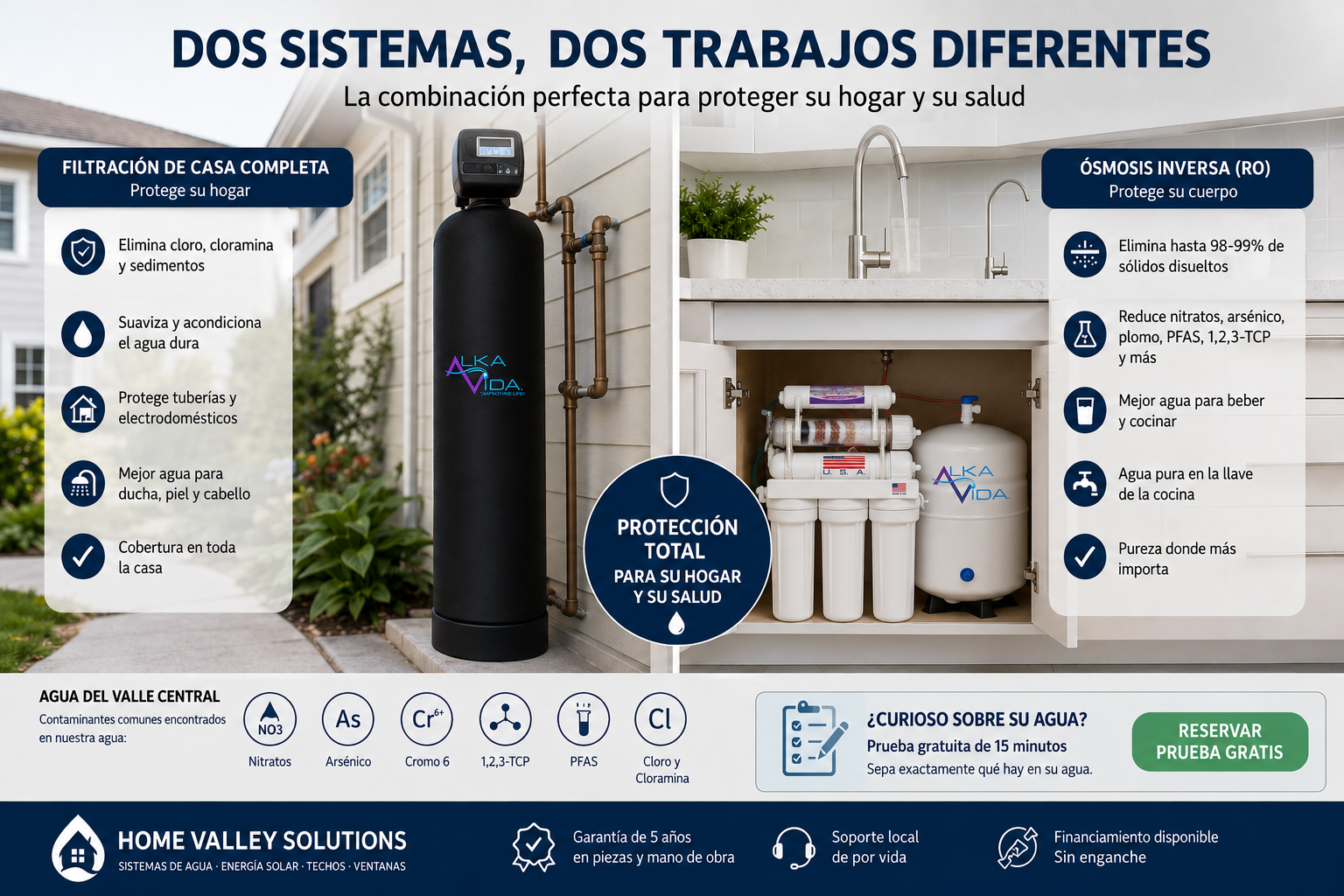
Reverse osmosis forces water through a semi-permeable membrane under pressure. The membrane has pores small enough to block dissolved ions — including calcium, magnesium, sodium, nitrates, arsenic, lead, fluoride, chloramine, and most agricultural chemicals. The output is water in the 10–50 ppm range: clean, neutral-tasting, and dramatically different from Atwater tap water.
A standard under-sink RO system serves the kitchen faucet and any refrigerator connection. A dedicated faucet is installed next to the main kitchen faucet. Water is stored in a small tank (typically 2–4 gallons) and replenished continuously. Flow rate is slower than a main tap — you fill a glass in a few seconds, not instantly.
RO systems require periodic maintenance: pre-filters need replacement every 6–12 months, the RO membrane every 2–3 years, and the post-filter annually. A well-maintained system produces consistently excellent water throughout its lifespan (typically 10–15 years for the housing; longer with membrane replacements).
For Atwater's high-TDS, high-hardness water, RO is the most effective point-of-use solution available. Nothing else achieves the same reduction across the broad range of dissolved solids present in Central Valley water.
[Learn more about our reverse osmosis systems for Atwater homes.](/services/reverse-osmosis?utm_source=blog&utm_medium=seo&utm_campaign=comparison_blogs&utm_content=tds-levels-atwater-why-water-tastes-bad-how-to-fix)
Whole-House Water Filtration and Softening
A whole-house system (point-of-entry system) treats all water entering your home before it reaches any fixture. This protects your water heater, pipes, appliances, and provides treated water for bathing and laundry — not just the kitchen sink.
In Atwater's context, whole-house treatment typically means a water softener (ion exchange to remove calcium and magnesium) combined with carbon filtration (to remove chloramine and organic compounds). This combination addresses scale, extends appliance life, improves soap lathering, and removes the chemical taste and odor from disinfectants.
A whole-house system will reduce TDS modestly — by removing hardness minerals (the largest contributors to Atwater's TDS) and replacing them with sodium. Whole-house treatment alone will typically not achieve the dramatic taste improvement that an RO system delivers at the drinking water faucet. The ideal solution for Atwater homes combines whole-house treatment with a dedicated RO or alkaline system for drinking and cooking.
[Explore whole-house filtration options for Atwater.](/services/water-filtration?utm_source=blog&utm_medium=seo&utm_campaign=comparison_blogs&utm_content=tds-levels-atwater-why-water-tastes-bad-how-to-fix)
Alkaline Water Systems
Alkaline water systems go beyond basic filtration to produce water with a controlled pH (typically 8.0–9.5) and a balanced mineral profile. Our AlkaVida system uses a multi-stage process that includes RO-level filtration followed by controlled remineralization with beneficial minerals.
The result is water that is clean (very low TDS from contaminants), slightly mineral (from the remineralization stage), and alkaline — a combination that many people find superior in taste to either raw tap water or flat RO water.
For Atwater families who have been purchasing bottled alkaline water, AlkaVida provides the same quality (or better, since you control the process and test it regularly) at a fraction of the ongoing cost.
[Learn about AlkaVida alkaline water systems.](/services/alkaline-water?utm_source=blog&utm_medium=seo&utm_campaign=comparison_blogs&utm_content=tds-levels-atwater-why-water-tastes-bad-how-to-fix)
Water Delivery / Bottled Water
Some Atwater families simply buy bottled water for drinking. This works in the short term but creates significant ongoing cost. A family drinking 3 gallons per day of bottled water spends $800–1,500 per year on water, with considerable plastic waste. Over five years, that's the cost of a complete home water treatment system — which would continue serving the household for another decade. The economics favor home treatment for virtually any family with consistent water consumption.
Additionally, bottled water quality varies significantly by brand, and many "purified" brands are simply municipal water that has been run through RO and rebottled. You may already be getting the equivalent of bottled water quality from a home RO system — at a fraction of the per-gallon cost.
---
Company-by-Company Breakdown: What You'll Actually Pay {#company-breakdown}
Here is an honest look at the major water treatment companies you're likely to encounter when researching solutions for Atwater water quality.
Comparison Overview
| Company | System Type | Estimated Cost | Review Rating | Local Atwater Service |
|---|---|---|---|---|
| Culligan | Rental (softener + RO) | $40–60/month | 3.2–3.8 stars | Dealer-dependent |
| RainSoft | Whole-house + RO purchase | $4,000–8,000 | 3.5–4.0 stars | Dealer-dependent |
| Puronics | Whole-house softener + RO | $3,000–6,000 | 1.8 stars | Limited local |
| Kinetico | Non-electric softener + K5 RO | $3,000–6,000 | 3.8–4.2 stars | Limited dealer |
| Generation H2O | Whole-house + RO | Market-rate | 5.0 stars | Regional |
| EcoWater | Softener + RO | $2,500–5,000 | 3.5–4.0 stars | Retail-dependent |
| SpringWell | Direct online (softener + RO) | $800–2,000 | 4.2–4.5 stars | No local service |
| APEC | Under-sink RO only | $200–500 | 4.4–4.7 stars | No local service |
| Aquasana | Whole-house carbon + RO option | $800–2,500 | 4.0–4.4 stars | No local service |
| Home Valley Solutions | Whole-house + RO + AlkaVida | Market-rate | 5.0 stars | Yes, fully local |
---
Culligan — $40–60/Month Rental
Culligan is the most recognized brand in residential water treatment, with a history spanning decades. Their rental model is the main draw: you don't pay a large upfront sum, and the company is technically responsible for maintenance. A water softener rental runs about $30–45/month. Adding a drinking water RO system brings the total to $50–60/month.
The long-term math problem: after five years at $55/month, you've paid $3,300 and own nothing. After ten years — $6,600. A quality purchased system serving the same function would cost $2,500–4,000 installed with a 10–15 year lifespan. You'd come out ahead financially and actually own the equipment by year 4 or 5.
Culligan also operates through a dealer network, meaning service quality varies significantly by region. Reviews in Central Valley markets reflect that variability. Dealers can be excellent or mediocre, and you have limited ability to predict which one you're getting before you sign a multi-year rental agreement.
If you go with Culligan, push for clarity on what happens if you want to cancel, what the fee structure is for missed service appointments, and what the exact path to ownership looks like if you later want to convert.
RainSoft — $4,000–8,000
RainSoft sells premium whole-house treatment systems through an in-home demonstration model. Their representatives will come to your home, conduct a theatrical water demonstration (turning your high-TDS water various colors, then showing how their treatment water looks different), and present a system proposal — often with same-night financing available.
The systems themselves are generally well-built. RainSoft's ECO-34 whole-house system combined with their drinking water RO can provide comprehensive treatment for Atwater's water quality issues. Long-term performance, when systems are properly maintained, is generally positive.
The concerns: the sales process is high-pressure and the pricing is at the top of the market. Customers consistently report feeling pushed to make a decision before the sales representative leaves. The systems are also sold with specific ongoing maintenance costs that can add up over years. Make sure you understand the total cost of ownership — installation, filter replacements, service contracts — before signing anything.
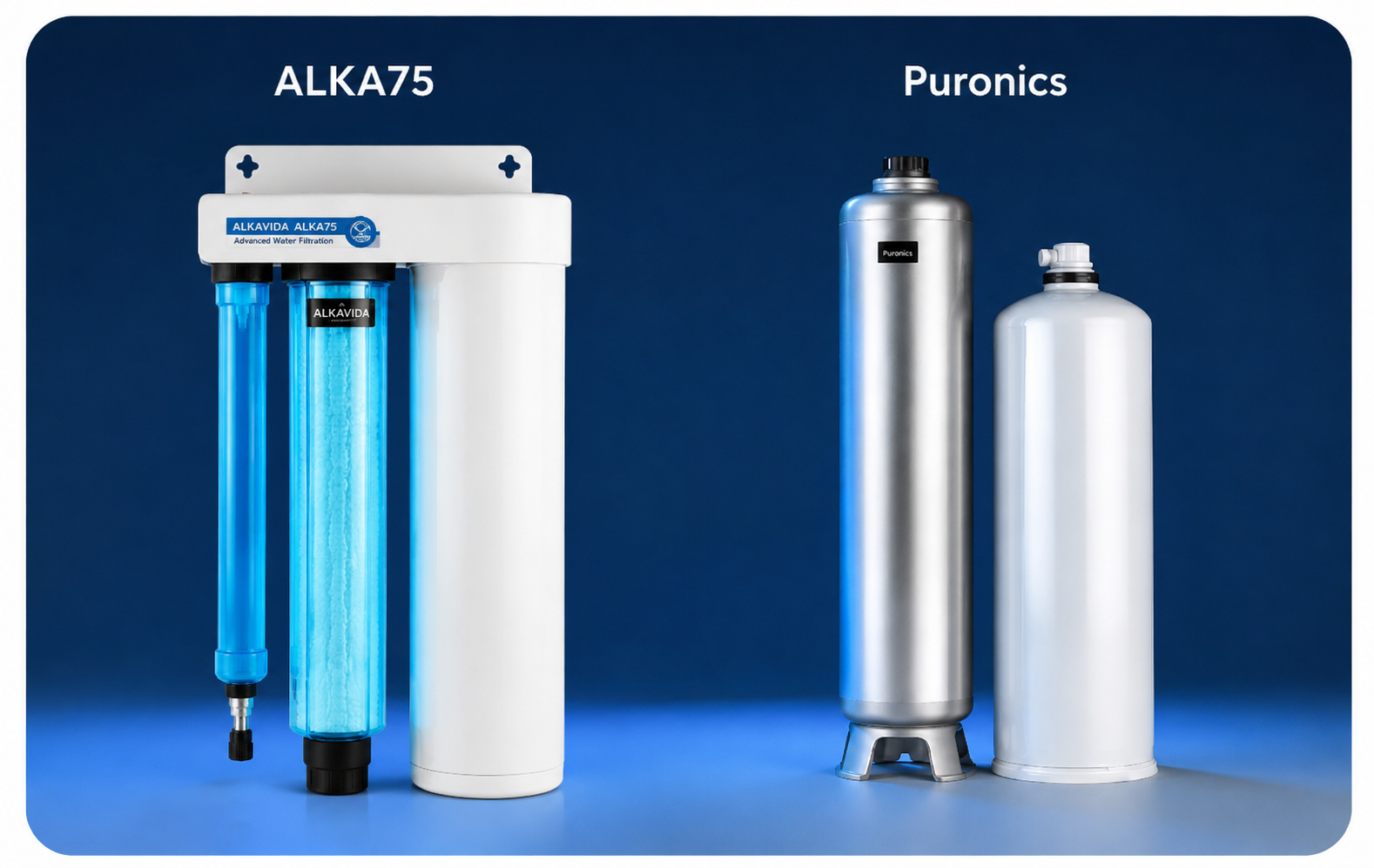
Puronics — $3,000–6,000 (1.8-Star Warning)
We need to be direct here. Puronics has a 1.8-star average rating across multiple review platforms and consumer complaint databases — a number that reflects not a single bad batch of reviews but a consistent, sustained pattern of customer dissatisfaction.
Common complaints across dozens of documented Puronics cases include:
- Aggressive and misleading sales demonstrations
- Equipment that does not perform as the sales representative described
- Extremely poor post-installation customer service
- Difficulty getting service appointments or responses to complaints
- Reported difficulty canceling contracts or getting deposits returned
- Multiple Better Business Bureau complaints in California markets
Puronics is actively marketed in the Central Valley, and their sales representatives approach Atwater homeowners regularly. Their pitch is polished. Their equipment can be effective. But the pattern of customer experience documented across California markets gives us serious pause.
We would not recommend Puronics without significant due diligence: independent third-party reviews, direct contact with documented current customers, and complete clarity on contract terms before signing.
Kinetico — $3,000–6,000
Kinetico makes genuinely excellent water treatment systems, and their non-electric, demand-initiated softeners are among the best-engineered products in the residential market. Rather than regenerating on a fixed timer, Kinetico softeners regenerate based on actual water usage — more efficient with salt and water, and ensuring you always have soft water available even after heavy usage periods.
Their K5 Drinking Water Station is one of the best-performing under-sink RO systems commercially available, with options for specific contaminant removal including a TDS-specific module. Kinetico is transparent about performance specifications and can document actual TDS reduction numbers.
For Atwater's combination of very hard water and high TDS, a Kinetico softener plus K5 combination is a technically excellent solution.
The practical limitation in the Atwater area: Kinetico operates through a dealer network, and Central Valley dealer coverage can be inconsistent. Response times, service availability, and local technician familiarity can vary significantly. Before purchasing Kinetico, verify that the specific dealer covering Atwater has adequate local presence for ongoing maintenance.
Generation H2O — 5.0 Stars
Generation H2O is a highly rated regional water treatment provider with strong customer satisfaction scores. Their 5.0-star rating across documented reviews reflects genuine customer satisfaction with both the systems and the service experience.
They can offer softener and RO combinations appropriate for Atwater's water quality profile. If you're considering Generation H2O, the key questions are: What specific system configuration are they recommending for your water test results, what is their local response time for service in Atwater specifically, and what does the ongoing maintenance program look like?
EcoWater — $2,500–5,000
EcoWater (a Pentair company) is a solid mid-to-premium option sold through a dealer network and, in some markets, through Costco with professional installation. Their systems are well-built, their softeners perform reliably, and their RO drinking water systems deliver good TDS reduction.
The Costco channel offers EcoWater softeners with professional installation at prices that are generally more competitive than the direct dealer channel — typically $1,500–2,500 for a softener with professional installation. Adding an RO system brings the total up. This represents reasonable value from an established brand.
Service quality depends on the local Costco-affiliated installer. Ask specifically about who will handle ongoing maintenance and whether that person is factory-trained or a general plumber.
SpringWell — $800–2,000 (Online Direct)
SpringWell sells direct-to-consumer online and has built a strong reputation in the water treatment DIY market. Their water softener and RO combination — the SS1 softener plus their under-sink RO — addresses Atwater's dual hardness and TDS problems at a price point significantly below the dealer/installer market.
Typical online pricing for the combination is $1,000–1,500 before local installation cost. If you hire a local plumber for installation, add $300–600. The total still comes in well below most dealer-installed systems.
The trade-off: no local presence. When you have a question, you call their customer service line (which is generally well-reviewed). When something needs service, you either DIY it or find a local plumber. For an Atwater homeowner who is comfortable with home systems and minor plumbing, this can be excellent value. For someone who wants a local expert they can call and who will come to the house, SpringWell is not the right fit.
APEC — $200–500 (Under-Sink RO Only)
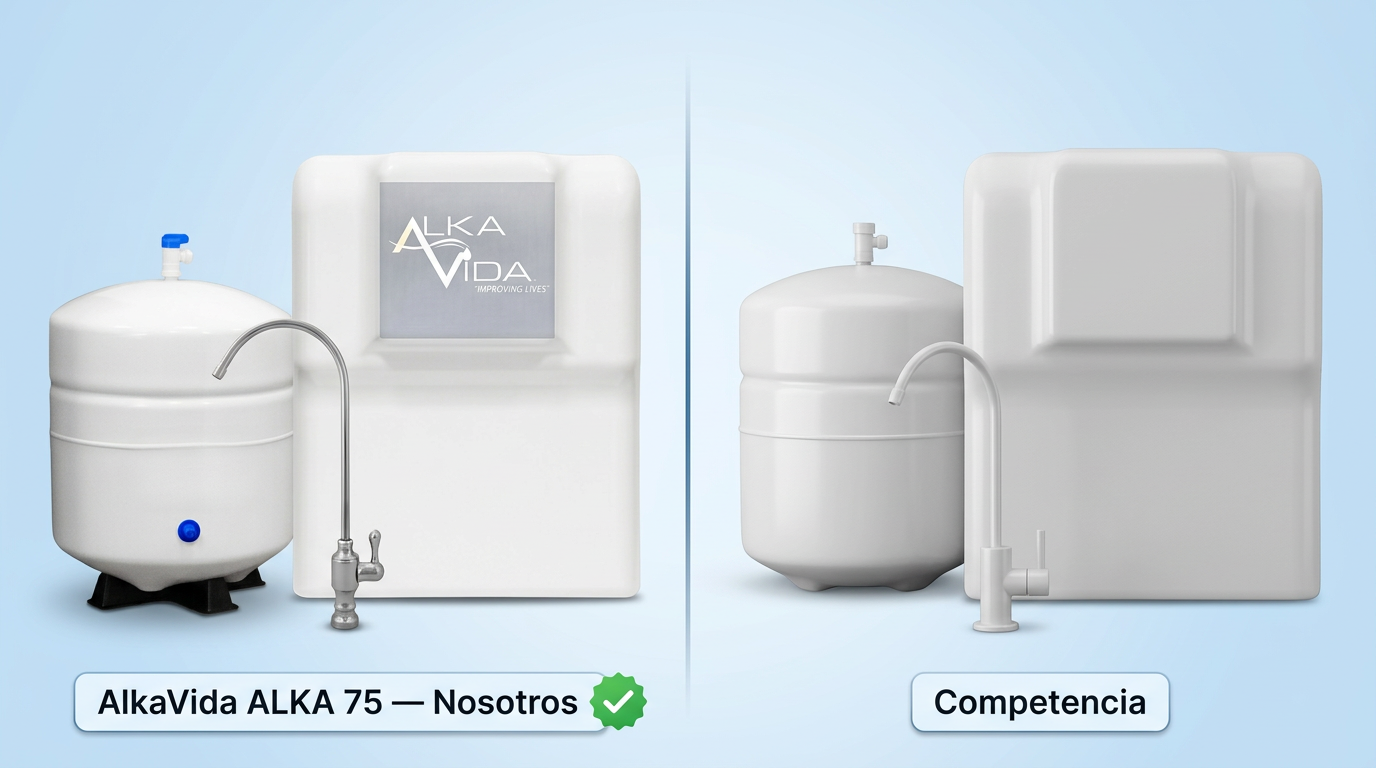
APEC makes the most consistently well-reviewed DIY reverse osmosis systems in the entry-to-mid price range. Their 5-stage ROES-75 system produces 75 gallons per day of RO-quality water at a retail price around $200–280. Performance is excellent — 93–97% TDS reduction is typical.
For an Atwater homeowner who wants dramatically better drinking water and is comfortable with basic under-sink plumbing, APEC is among the best value propositions available. The water quality improvement you'll experience is comparable to systems that cost 5–10 times more.
The limitation is scope. APEC addresses one faucet. It does not address hardness, it does not protect your water heater or appliances, it doesn't help your shower or laundry. It's a drinking water solution, not a whole-house solution. Know what you're buying.
Aquasana — $800–2,500
Aquasana's whole-house Rhino system is popular and well-reviewed for what it does: removing chlorine, chloramine, and some organic compounds throughout the house. It does not meaningfully reduce TDS — dissolved calcium, magnesium, sodium, nitrates, and bicarbonates pass through essentially unchanged.
This matters for Atwater residents considering Aquasana specifically to address water taste. If the taste issue is primarily chloramine (the disinfectant), Aquasana's whole-house system will help. If the taste issue is the mineral load — the chalky, heavy, minerally character of Atwater water — Aquasana's whole-house system will not solve it.
Aquasana's OptimH2O under-sink RO system does achieve meaningful TDS reduction and would address drinking water taste issues. The combination of their whole-house system for chloramine removal plus their under-sink RO for TDS reduction is a reasonable approach.
---
Why Atwater Families Choose Home Valley Solutions {#why-hvs}
We are a local family business — not a national franchise, not a dealer for a single manufacturer, and not a company that earns commissions on alarming you about your water. We serve the Central Valley because we live here. We understand what TDS looks like in Atwater specifically, what seasonal variation means for nitrate readings near the ag zones south of town, and what combination of systems actually works for the range of water quality conditions this region presents.
What makes us different:
We test first, recommend second. Our free water test is a genuine diagnostic — not a sales demonstration. We bring accurate instruments, test for the parameters that matter in this specific region, and give you real numbers with honest interpretation. If your water test doesn't show a problem that a treatment system would meaningfully solve, we tell you that. We would rather send you home with accurate information than sell you something you don't need.
We speak your language. Our team is fully bilingual in English and Spanish. For many Atwater families, being able to discuss something as technical as water treatment in Spanish — and trust that nothing is being summarized or glossed over — is essential. We never leave a consultation without ensuring complete, clear communication about what we found and what we recommend, regardless of language preference.
We carry solutions matched to Central Valley conditions. Our systems are not designed for a generic national market with average water hardness and average TDS. They are configured for the specific mineral content, TDS range, and contaminant profile common to Atwater and Merced County. This means correctly sized softener capacity for 12–25 gpg water, RO membranes sized for appropriate flow rate given local water pressure and TDS, and pre-filtration designed for the sediment loads common in this water supply.
The AlkaVida difference. Our AlkaVida alkaline water system is not available from national chains. It is designed for families who want more than just filtered water — who want water that actively supports their family's health and wellbeing. AlkaVida produces mineral-balanced, alkaline water that tastes genuinely excellent. For families spending $100+ per month on bottled alkaline or spring water, AlkaVida pays for itself within a few years while delivering better-documented water quality than anything in a bottle.
No pressure, ever. We do not run high-pressure sales demonstrations. We do not offer same-night-only discounts. We do not use fear about your water quality to push a buying decision. We test, explain, and let you decide on your timeline. Our reputation in this community is built on honest service, and we don't sacrifice that for a short-term sale.
Local service for the life of the system. When your RO membrane needs replacement two years from now, when your softener needs its salt check, when you have a question about your system's performance — you call (559) 507-6838 and talk to someone who knows your specific system, your home, and your water. Not a national call center routing you to whichever technician is available in the region. A local team that is accountable to the same community where you live.
[Book a free water test today — no commitment required.](/free-water-test?utm_source=blog&utm_medium=seo&utm_campaign=comparison_blogs&utm_content=tds-levels-atwater-why-water-tastes-bad-how-to-fix)
[View all our water treatment services for Atwater homes.](/services/water-filtration?utm_source=blog&utm_medium=seo&utm_campaign=comparison_blogs&utm_content=tds-levels-atwater-why-water-tastes-bad-how-to-fix)
---
Frequently Asked Questions {#faq}
What is a normal TDS level for drinking water in Atwater?
There is no single "normal" because readings vary by neighborhood, proximity to agricultural areas, whether you're on city water or a private well, and the season. Atwater municipal water typically tests in the 200–500 ppm range. Private wells can be lower or significantly higher — readings above 600 ppm are not uncommon in well water in the areas surrounding the city.
The EPA's secondary standard is 500 ppm, but this is an aesthetic guideline, not an enforceable health standard. Most water quality professionals consider 50–150 ppm ideal for drinking water — a range achievable with a well-configured reverse osmosis system starting from any municipal source in Atwater.
Is high-TDS water in Atwater dangerous to drink?
It depends entirely on what is dissolved in the water. High mineral content (primarily calcium and magnesium) is generally not dangerous and may even contribute modestly to mineral intake. However, high TDS in Atwater water may also reflect elevated nitrates (a concern especially for infants), trace agricultural chemicals, and heavy metals in some areas.
A TDS meter tells you that something is in the water. Only a comprehensive laboratory test tells you what. If you are on a private well, have an infant in the household, or have a health condition that makes specific contaminants relevant to you, a lab water analysis is essential — not optional.
Will a water softener fix my high TDS problem?
A water softener will address the hardness component of TDS — the calcium and magnesium that are typically the largest contributors to Atwater's elevated readings. This protects appliances and reduces scale. However, a softener trades calcium and magnesium for sodium, so total TDS reduction is modest (perhaps 15–25%). Bicarbonates, sulfates, nitrates, and other dissolved compounds remain unchanged.
For drinking water that tastes genuinely different — clean, neutral, low in dissolved mineral content — a water softener alone is not enough. Pairing a softener with an under-sink RO system is the standard recommendation for Atwater homes that want both appliance protection and excellent drinking water.
How much does it cost to fix high TDS water in Atwater?
The cost range is wide depending on the solution scope. A point-of-use RO system for the kitchen only runs $200–500 for DIY installation or $600–1,200 professionally installed. A whole-house water conditioner or softener adds $1,200–2,500 professionally installed. A complete whole-house system (softener + carbon filtration + sediment pre-filter + RO for drinking) runs $2,500–5,000 installed, depending on home size and specific configuration.
Ongoing costs for filter replacements and annual service typically run $150–400 per year. We provide specific pricing after testing your water and understanding your home's configuration — not before, because the right system for your specific water and home may differ from a neighbor's.
How often should I test my well water in Atwater?
At minimum, test annually for nitrates and coliform bacteria — the two highest-priority concerns in Merced County well water. Test TDS annually as a baseline. Any time you notice a change in taste, color, or odor, test immediately — these are often early indicators of a change in water quality that warrants investigation.
If you have a water treatment system, test both before and after the system at least annually to verify that treatment performance is being maintained. Membranes and filters degrade over time, and a system that performed at 95% efficiency when installed may drop to 70% if not maintained — without any visible change you'd notice without testing.
Can high TDS damage my plumbing and appliances?
Yes, significantly and predictably. The calcium carbonate that causes Atwater's hardness deposits as scale inside pipes, on heating elements, and inside appliances as the water is heated or evaporated. Scale is a thermal insulator — a layer as thin as 1/4 inch on a water heater element reduces its efficiency by roughly 40% and shortens its lifespan dramatically.
Tankless water heaters in hard water areas without treatment can fail in 4–7 years; with proper softening, the same unit routinely lasts 15–20 years. Dishwashers, ice makers, washing machines, and coffee makers all face similar accelerated wear from scale. The cost of a whole-house softener is almost always recovered in extended appliance life within the first 3–5 years.
What is the difference between a water softener and a water conditioner?
A traditional water softener uses ion exchange — removing calcium and magnesium from water and replacing them with sodium. It physically removes hardness minerals from the water, which reduces scale, extends appliance life, and improves soap lathering. The output is chemically softened water.
A salt-free water conditioner (also called a scale inhibitor or template-assisted crystallization system) does not remove minerals — it changes the form in which they exist, making them less likely to adhere to surfaces as scale. TDS is unchanged. The water still contains all the dissolved minerals; they just behave differently. Salt-free conditioners are appropriate in some specific situations but will not produce the full benefits of a true softener for Atwater's 12–25 gpg hardness levels.
Does Home Valley Solutions offer financing?
We offer flexible options to make water treatment accessible for Atwater families. During your free water test consultation, we'll discuss the system configuration that matches your needs and the payment options available. We believe every family deserves access to clean, safe water — and we work to make that accessible.
[Book a free consultation to discuss options.](/appointment?utm_source=blog&utm_medium=seo&utm_campaign=comparison_blogs&utm_content=tds-levels-atwater-why-water-tastes-bad-how-to-fix)
---
Take Action: Get Your Free Water Test in Atwater {#cta}
If you've read this far, you understand that Atwater's water quality is a genuine issue deserving a thoughtful response. TDS readings of 200–500+ ppm, hardness of 12–25 gpg, agricultural nitrate concerns, and the specific challenges of private well water in Merced County all add up to a water quality environment that affects your health, your appliances, your daily comfort, and your grocery bill (if you're buying bottled water).
The first step is knowing what's actually in your water — not a utility report from months ago, not a neighbor's TDS meter reading, but a current, specific test of your home's water at the point where your family uses it.
Home Valley Solutions offers free professional water testing throughout Atwater and Merced County. We bring calibrated instruments to your home, test on-site, explain every result in plain English or Spanish, and give you specific, honest recommendations with no pressure and no obligation.
If a treatment system is the right answer, we'll tell you which one and why — based on your actual water chemistry, your home's configuration, and your family's specific needs. If your water doesn't warrant treatment, we'll tell you that instead.
Your family drinks water every day. They cook with it. They bathe in it. Getting clear about what's in it is not a luxury — it's a straightforward thing you can do today, at no cost.
Call us: (559) 507-6838
[Schedule your free water test — no commitment, no obligation.](/free-water-test?utm_source=blog&utm_medium=seo&utm_campaign=comparison_blogs&utm_content=tds-levels-atwater-why-water-tastes-bad-how-to-fix)
[See our full range of water treatment services for Atwater homes.](/services/water-filtration?utm_source=blog&utm_medium=seo&utm_campaign=comparison_blogs&utm_content=tds-levels-atwater-why-water-tastes-bad-how-to-fix)
[Learn about reverse osmosis systems designed for Central Valley water.](/services/reverse-osmosis?utm_source=blog&utm_medium=seo&utm_campaign=comparison_blogs&utm_content=tds-levels-atwater-why-water-tastes-bad-how-to-fix)
[Explore AlkaVida alkaline water — better than bottled, better for your family.](/services/alkaline-water?utm_source=blog&utm_medium=seo&utm_campaign=comparison_blogs&utm_content=tds-levels-atwater-why-water-tastes-bad-how-to-fix)
[Book an appointment with our Atwater water specialists.](/appointment?utm_source=blog&utm_medium=seo&utm_campaign=comparison_blogs&utm_content=tds-levels-atwater-why-water-tastes-bad-how-to-fix)
---
Home Valley Solutions is a local, family-owned water treatment company serving Atwater, Merced, Livingston, Los Banos, Turlock, and communities throughout Merced County and the Central Valley. We offer free water testing, bilingual service in English and Spanish, and honest recommendations with no sales pressure. Call us at (559) 507-6838.
¿Listo para mejorar la calidad de su agua?
Obtenga una prueba de agua gratuita y descubra cómo podemos ayudarle.