
Californians spend more on bottled water and residential water filtration than residents of virtually any other state. And it's understandable: California's water is complex, varied, and — in many regions, especially the Central Valley — genuinely challenging. High mineral content, agricultural contamination, aging infrastructure, and the chemical burden of disinfection treatments all give homeowners legitimate reasons to think seriously about what's coming out of their taps.
But the water filtration industry is also one where consumers are at risk of being sold more than they need, or the wrong thing entirely. High-pressure sales tactics, misleading in-home demonstrations, and the dizzying array of technologies and products make it easy for homeowners to end up with systems that don't solve their actual problem — or that solve one problem while ignoring others.
The best protection against a bad purchase is good information. These 10 questions will help you navigate the market, evaluate any company you talk to, and make a decision based on your actual water needs rather than a salesperson's agenda.
Question 1: What's Actually in My Water?
This is the foundational question — and the answer should come before any product recommendation.
Many water filtration companies conduct in-home "water tests" as part of their sales process. Some of these are legitimate and informative. Others are designed to produce alarming results that drive purchase decisions, using test strips or reagents that exaggerate common findings or fail to detect what they claim to detect.
What you should do: Get an independent water test before meeting with any vendor. Options include:
- Your water utility's annual Consumer Confidence Report (CCR) — California water utilities are required to publish this annually. It shows what contaminants were detected in your water supply over the past year and whether any exceeded regulatory limits. Available on your utility's website or by request.
- A certified lab test — For a more detailed picture, or for private well owners, a certified laboratory test analyzes your water against a panel of contaminants. The California State Water Resources Control Board maintains a list of certified labs. A basic panel covering the most common residential concerns typically runs $50-150.
- A free in-home test from a reputable provider — Home Valley Solutions offers a free in-home water test that covers hardness, TDS, chlorine, and other key parameters. The difference: their test is designed to inform the recommendation, not to alarm you into a purchase. If you don't need a whole-house system, they'll tell you.
[Schedule your free water test with Home Valley Solutions](https://homevalleysolutions.com/free-water-test?utm_source=blog&utm_medium=seo&utm_campaign=comparison_blogs&utm_content=top-10-questions-before-buying-water-filter-california)
Knowing your water's actual composition — its hardness, its chlorine content, its nitrate level, its TDS — puts you in control of the conversation with any vendor.
---
Question 2: What Technology Actually Solves My Problem?
Water filtration is not one-size-fits-all. Different contaminants require different treatment technologies, and the best system for your neighbor might not be the best system for you.
Common problems and the technologies that address them:
Hard water (calcium and magnesium scale): Salt-based ion exchange water softener. This is the only technology that actually removes calcium and magnesium from water. Salt-free "conditioners" change how minerals behave but don't remove them — they provide limited protection for plumbing and appliances in hard water above 7-10 grains per gallon. For most of the Central Valley, where hardness often exceeds 10 gpg, a salt-based softener is the right answer.
Chlorine and chloramine taste/odor: Activated carbon filtration. Either a whole-house carbon filter or a point-of-use carbon filter at the kitchen tap. This is one of the simplest, most cost-effective interventions available and dramatically improves the taste and smell of most California municipal water.
Nitrates (from agricultural areas): Reverse osmosis or ion exchange (specific to nitrates). Carbon filtration does NOT effectively remove nitrates — a common misconception. If nitrates are your concern (especially relevant for Central Valley households near agricultural areas), make sure the system you're being sold actually addresses them.
Arsenic: Reverse osmosis or activated alumina filtration. Arsenic appears naturally in some California groundwater, particularly in parts of the Central Valley. Not all filtration systems remove arsenic — confirm with the vendor and the system's NSF certification.
Lead and copper: Reverse osmosis or certified NSF 53 carbon block filters. Lead in drinking water typically enters from plumbing — old pipes or solder — rather than the source water itself. An under-sink RO system at the kitchen tap addresses this effectively.
Bacteria and pathogens (well water): UV treatment or ultrafiltration, often combined with other technologies. Well water homeowners in California should test specifically for bacteria and confirm any system they're considering has appropriate treatment capacity.
The key point: If a salesperson recommends a single system as the solution to everything without asking about your specific water test results and your specific concerns, be skeptical. A legitimate provider matches the technology to the problem.
[Learn how HVS selects the right solution for Central Valley water](https://homevalleysolutions.com/services/water-filtration?utm_source=blog&utm_medium=seo&utm_campaign=comparison_blogs&utm_content=top-10-questions-before-buying-water-filter-california)
---
Question 3: What Is This System Certified to Remove?
NSF International (formerly National Sanitation Foundation) certifies water treatment systems against published standards. These certifications are the clearest objective evidence that a system performs as claimed.
Key NSF standards:
- NSF 42: Aesthetic effects — chlorine, chloramine, taste, odor, particulates
- NSF 44: Cation exchange water softeners (hardness reduction)
- NSF 53: Health effects — lead, arsenic, cysts, VOCs, and other health-relevant contaminants
- NSF 58: Reverse osmosis systems
- NSF 401: Emerging contaminants — pharmaceuticals, hormones, certain pesticides
When a salesperson tells you their system removes something, ask: "Is that removal claim certified by NSF?" If the answer is no, the claim is marketing, not science. Systems that carry NSF certifications have been independently tested at their claimed flow rates with real water under real conditions.
Be specific: a system certified to NSF 42 removes chlorine effectively. It does not necessarily remove lead, arsenic, nitrates, or anything else covered by NSF 53. A system that removes one contaminant class doesn't automatically remove others.
Any reputable California water treatment company — including Home Valley Solutions, Culligan, Puronics, EcoWater, Kinetico, and others — will readily provide NSF certification documentation for the systems they install. If a company resists or deflects this question, walk away.
---
Question 4: Whole-House or Point-of-Use — Which Do I Actually Need?
This is one of the most practical questions, and the answer depends on your goals.
Whole-house systems (also called point-of-entry systems) treat all water entering your home before it reaches any tap, appliance, or fixture. Every shower, every toilet, every dishwasher cycle, every load of laundry uses treated water. This is the right approach for:
- Hard water scale prevention (a softener does nothing if it only treats one tap)
- Protecting plumbing and appliances from scale or corrosion
- Chlorine removal throughout the house (so you're not absorbing chlorine through your skin in the shower)
- Overall home water quality improvement
Point-of-use systems (under-sink filters, countertop filters, RO systems) treat water at a single outlet — typically the kitchen tap. This is the right approach for:
- Drinking and cooking water purity
- Specific contaminant removal (lead, nitrates, arsenic) that isn't addressed by whole-house systems
- Households in rental situations where whole-house installation isn't permitted
- Budget-conscious households who want to prioritize drinking water first
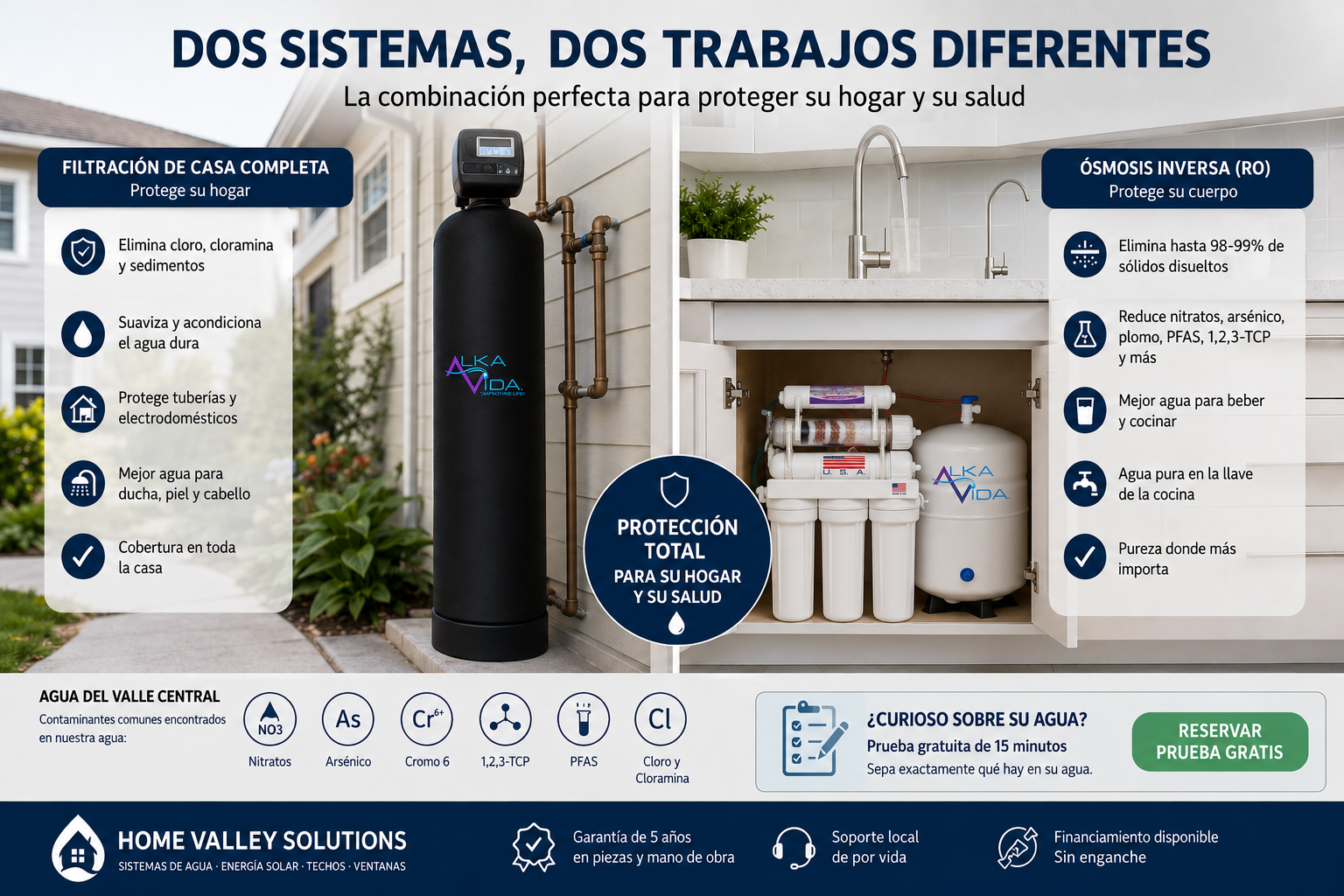
The most comprehensive approach — and what most Central Valley homeowners who invest in water treatment ultimately end up with — is a combination: a whole-house system (softener + carbon filter) at the point of entry, plus an under-sink RO unit at the kitchen tap. The whole-house system protects the home; the RO system delivers the purest possible drinking water.
[Compare whole-house filtration and RO options from HVS](https://homevalleysolutions.com/services/reverse-osmosis?utm_source=blog&utm_medium=seo&utm_campaign=comparison_blogs&utm_content=top-10-questions-before-buying-water-filter-california)
---
Question 5: What Is the True Total Cost of Ownership?
Water treatment equipment has an upfront cost and an ongoing cost, and focusing only on the installation price gives you an incomplete picture.
For water softeners:
- Upfront: $800-3,000+ depending on capacity and brand
- Salt: $50-150/year for a typical household (varies by water hardness and usage)
- Resin replacement: Every 10-15 years typically; cost varies
- Electricity: Minimal for most modern units
For whole-house carbon filters:
- Upfront: $500-2,500+
- Media/filter replacement: Varies by system; typically $100-300/year
- No salt required
For under-sink RO systems:
- Upfront: $300-800 for the system; $100-200 for installation
- Filter replacement: $50-150/year typically (pre-filters, carbon filters)
- Membrane replacement: Every 2-5 years; $50-150 for the membrane
The lease/rental model: Culligan and some other national brands offer rental agreements that minimize upfront cost. These can be attractive but typically cost more over the long run than purchasing. Do the math on total cost over 5-10 years before choosing this option.
Ask every vendor: "What is my total cost of ownership over 10 years, including all consumables and maintenance?" A vendor who can't or won't answer this clearly is not someone you should trust with a significant home investment.
---
Question 6: Who Provides Service, and How Do I Reach Them?
A water treatment system is a long-term investment that needs ongoing attention. Before you sign anything, understand exactly who will be servicing your system and how.
Key questions:
- Is service provided locally, or through a national call center?
- What's the typical response time for service calls in my area?
- Is maintenance included in the purchase price, or is it additional?
- What happens if the company I bought from goes out of business?
- Is there a local technician who knows my specific installation?
Local companies like Home Valley Solutions provide service through the same team that sold and installed your system. They know your home, your water, and your system. When you call, you reach someone local who can dispatch a technician who knows what they're walking into.
National brand franchise operations vary. Some franchisees provide excellent local service; others are stretched thin or route service issues through corporate channels. Ask specifically about local service capacity and ask for references from existing customers in your area.
For direct-to-consumer brands (Aquasana, SpringWell, etc.), service typically means troubleshooting via phone or email and shipping replacement parts. This works fine for experienced homeowners but can be frustrating when you need hands-on help.
---
Question 7: Is This System Right for My Specific Home?
Not all water treatment systems work the same way in every home. Sizing matters enormously.
For water softeners: The right size depends on your household size, your daily water consumption, and your water hardness level. A softener sized too small for your household will exhaust its resin before completing a regeneration cycle, meaning some water at peak demand periods won't be softened. A softener sized too large regenerates inefficiently, wasting salt and water.
For whole-house filtration: Flow rate matters. A filter designed for a small apartment won't provide adequate filtration at the flow rates of a large family home. Undersizing leads to reduced filter effectiveness as water rushes through faster than the media can treat it.
For RO systems: Tank capacity and membrane flow rate should be matched to your household's drinking water demand. A system with too small a storage tank will run out of filtered water during periods of high use; a system with too large a membrane wastes water unnecessarily.
A reputable company sizes systems to your household after asking about your family size, daily water use, peak demand periods, and your water test results. If a salesperson recommends a specific system without asking these questions, the recommendation is not based on your actual needs.
Home Valley Solutions conducts this assessment as part of their free in-home consultation process. The system they recommend reflects your household's specific situation — not a default upsell to the biggest available unit.
---
Question 8: What Does the Warranty Actually Cover?
Water treatment warranties vary dramatically in their coverage, duration, and practical value. Understanding what you're actually protected against prevents unpleasant surprises later.
Questions to ask about the warranty:
- What is the warranty period for the tank/housing? For the electronic controls? For the media?
- Does the warranty cover parts only, or labor as well?
- What voids the warranty? (Using non-approved salt, having the system serviced by a third party, and certain water conditions can all void warranties with some brands)
- Who honors the warranty — the manufacturer, the dealer, or both?
- What is the process for making a warranty claim?
Industry-standard warranties for quality softeners and filtration systems typically run 5-10 years on the tank and controls, with some brands offering lifetime warranties on the tank. Labor warranties are typically shorter.
Be particularly careful about warranties from brands you can't verify the longevity of. A 10-year warranty is only valuable if the company will still exist in 10 years. This is one advantage of nationally established brands like Culligan, EcoWater, Kinetico, and Puronics — they're unlikely to disappear, and warranty claims can be pursued through the national organization even if a local dealer changes.
For local companies, ask how long they've been in business and what their warranty honoring process looks like. Home Valley Solutions, as a family business with long-term presence in the Central Valley, backs their installations with service commitments that reflect their stake in local reputation.
---
Question 9: Does the Company Use High-Pressure Sales Tactics?
This question is about protecting yourself from a buying decision made under artificial pressure.
The water treatment industry has an unfortunate reputation for high-pressure in-home sales. Common tactics include:
- The alarm test: An in-home "demonstration" that uses tests designed to produce alarming results (red color when chemical is added to your water, high TDS readings presented as dangerous, etc.) to create urgency. In reality, many of these tests measure normal minerals or treatment chemicals rather than dangerous contamination.
- The today-only price: A quote that is only valid if you sign before the salesperson leaves. This is designed to prevent you from comparison shopping, getting a second opinion, or taking time to think.
- The authority figure close: Bringing in a "manager" or "quality control specialist" who offers a special deal as an additional pressure tactic.
- The fear close: Emphasizing health risks from your current water in a way that creates emotional urgency to buy.
How to protect yourself:
- Never make a same-day decision on a water treatment system
- Get at least two quotes before committing
- Insist on written quotes that are valid for at least 7-10 days
- Take the salesperson's presentation materials home and review them before deciding
- Ask specifically: "What would happen to this price if I called you next week?" If the answer is "this price is only for today," that tells you something important about how this company operates.
A company that is confident in the value of its products and services will give you time to make a good decision. Home Valley Solutions operates on this principle — they describe their approach as "no pressure" specifically because they believe informed customers make better long-term partners.
[Schedule a no-pressure consultation with HVS](https://homevalleysolutions.com/appointment?utm_source=blog&utm_medium=seo&utm_campaign=comparison_blogs&utm_content=top-10-questions-before-buying-water-filter-california)
---
Question 10: How Does This Company Handle the Central Valley's Specific Water Conditions?
This question is specific to California and particularly to homeowners in the Central Valley — but the principle applies anywhere: a good water treatment company should know your local water.
The Central Valley's water challenges are not generic:
- Arsenic: Detected in groundwater in Tulare, Kings, and other Valley counties. Some national brand representatives don't know to ask about this or test for it.
- Chromium-6: California has set specific standards for hexavalent chromium, which appears in some Valley water sources. Not all systems address this contaminant.
- Agricultural nitrates: The Valley's intensive agriculture has left a legacy of nitrate contamination in groundwater that persists even in areas now on municipal water. Well water households are especially at risk.
- Seasonal variation: Water hardness and composition can vary significantly in the Valley between seasons, as the mix of surface water and groundwater shifts. A system sized and set for summer water conditions may behave differently in winter, and vice versa.
- Spanish-language service: A significant portion of Central Valley homeowners are most comfortable communicating in Spanish. For a major home investment, being able to fully understand what you're buying and what your system does — in your primary language — is not a convenience, it's a necessity.
Local companies that serve the Central Valley day in and day out — like Home Valley Solutions — understand these nuances in a way that a national call center never can. Ask any company you're considering: "How do you account for Fresno's/Modesto's/Visalia's specific water conditions when you recommend a system?" The answer will tell you a great deal about how seriously they take the local expertise part of their business.
[Learn about HVS's Central Valley water expertise](https://homevalleysolutions.com/services/water-filtration?utm_source=blog&utm_medium=seo&utm_campaign=comparison_blogs&utm_content=top-10-questions-before-buying-water-filter-california)
---
Bonus: The Companies That Answer These Questions Best
Here's a brief rundown of how the major providers in the Central Valley and California typically perform against these 10 questions:
Home Valley Solutions — Strong across all 10. Free water test, local expertise, no-pressure approach, bilingual service, systems sized to actual needs. Best local option in the Central Valley.
Culligan — Strong on warranty and certification documentation. Variable on pressure tactics depending on the franchise location. Pricing transparency sometimes requires persistence.
EcoWater — Strong on product documentation and efficiency data. More consistent on pricing transparency than some competitors. Good on warranty terms.
Kinetico — Excellent on technology differentiation and efficiency. Pricing can be high and the sales process lengthy. Strong warranty.
Puronics — Strong on technology and product quality. Sales process can be high-pressure. Worth getting a second quote.
Generation H2O — Local, approachable, honest. Good local knowledge. Slightly more limited on product range than national brands.
Aquasana / SpringWell — Excellent on product documentation and NSF certification. Challenging on local service support. Best for experienced, self-sufficient homeowners.
559 Water Filters — Competitive pricing, local knowledge, straightforward approach. Limited on comprehensive whole-home solutions.
Clean Valley Water / AAA Water Systems / Crystal Water Line — Solid local options with personalized service. Variable on documentation and warranty formality; ask the right questions and verify in writing.
---
The Questions in Summary
Before you buy any water filter or treatment system in California:
1. Get your water tested independently before any vendor visit 2. Understand which technology addresses your actual contaminants 3. Verify NSF certifications for the specific claims being made 4. Determine whether you need whole-house or point-of-use (or both) 5. Calculate total cost of ownership over 10 years 6. Understand exactly who services the system and how to reach them 7. Confirm the system is properly sized for your household 8. Read the warranty carefully before signing 9. Walk away from any company that won't give you time to think 10. Choose a company with local knowledge of your specific water conditions
Follow these steps and you'll make a better decision than the vast majority of California homeowners who buy water treatment systems. You'll know what you need, why you need it, and whether the company you're talking to is genuinely trying to solve your problem.
[Start with a free HVS water test — the first question answered for free](https://homevalleysolutions.com/free-water-test?utm_source=blog&utm_medium=seo&utm_campaign=comparison_blogs&utm_content=top-10-questions-before-buying-water-filter-california)
---
One More Thing: Alkaline Water
If you've already resolved your basic filtration and softening needs and are looking at what's next, alkaline water is worth exploring. Home Valley Solutions offers the AlkaVida system — a proprietary alkaline water solution unique to HVS in the Central Valley that produces mineral-rich, pH-balanced drinking water through natural media rather than electronic ionization.
Families that have made the switch describe noticeably better taste and a preference for their home's water over any bottled option. If alkaline water is on your radar, ask HVS about AlkaVida during your consultation.
[Learn about AlkaVida alkaline water](https://homevalleysolutions.com/services/alkaline-water?utm_source=blog&utm_medium=seo&utm_campaign=comparison_blogs&utm_content=top-10-questions-before-buying-water-filter-california)
---
This guide was last updated September 2026. It reflects general water treatment industry practices and the specific conditions of California's Central Valley. For specific water quality concerns, consult your local water utility's Consumer Confidence Report and a certified water treatment professional.
¿Listo para mejorar la calidad de su agua?
Obtenga una prueba de agua gratuita y descubra cómo podemos ayudarle.